The Bitcoin Lightning Network Explained: Instant, Cheap Bitcoin Payments

Ashir Khan writes about cryptocurrency security, self-custody, macro market analysis, and regulatory policy at CryptoBeacon.
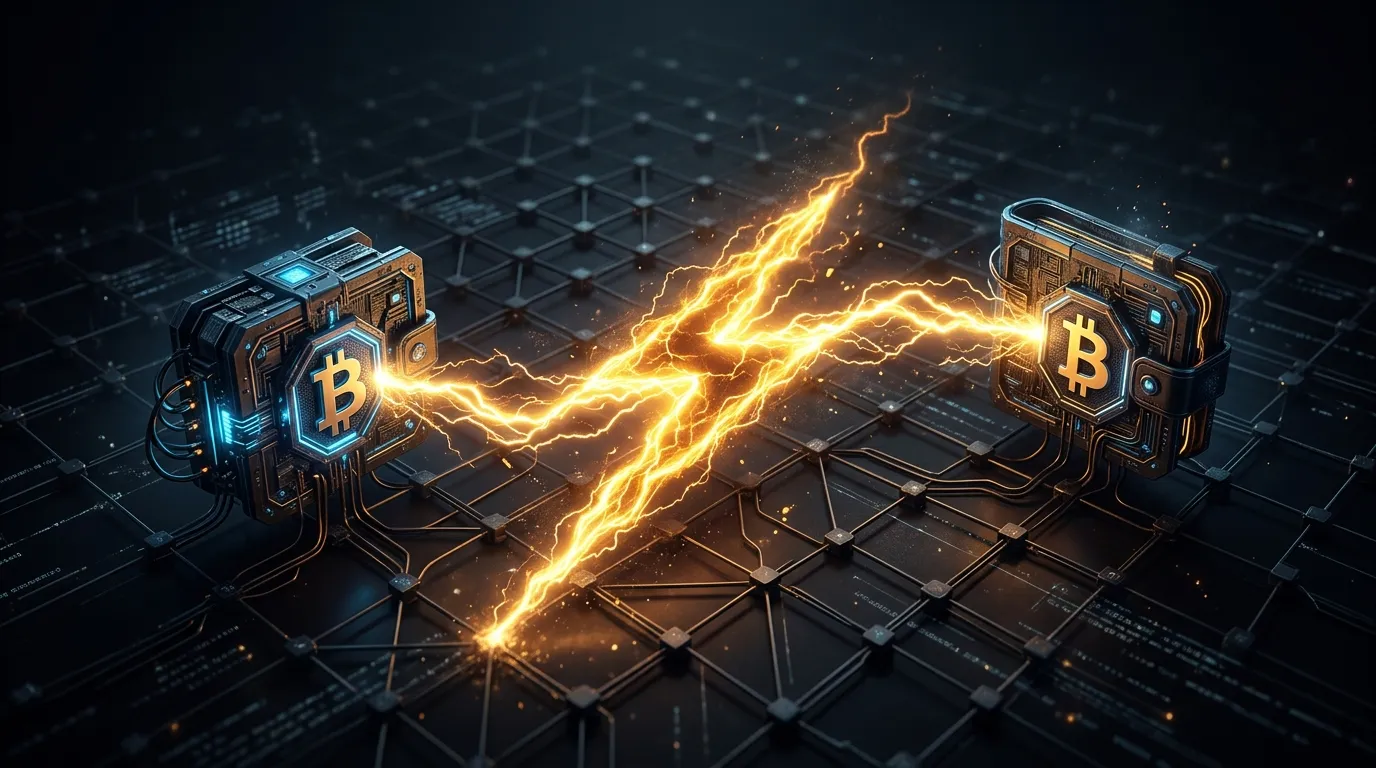
Bitcoin's base layer — the blockchain — processes roughly 7 transactions per second globally. For a payment network aspiring to serve billions of people, that is a bottleneck. The Lightning Network is Bitcoin's primary solution: a second-layer protocol that enables near-instant, low-fee payments without touching the blockchain for every transaction.
This article is educational. It isn't financial advice.
Why Bitcoin Needs a Second Layer
Every on-chain Bitcoin transaction must be broadcast to the entire network, included in a block by a miner, and then confirmed by thousands of full nodes worldwide. This process takes 10 minutes on average for the first confirmation (more for higher security), and each block has limited space — meaning demand drives fees up during congestion.
For buying coffee or making micropayments, this model is impractical. The Lightning Network solves this by moving the bulk of transactions off-chain between parties who trust each other to settle — and only uses the blockchain to open and close the channel.
How Payment Channels Work
A Lightning payment channel is a two-party relationship secured by a multi-signature Bitcoin transaction locked on-chain. Here's how it works step by step:
- Alice and Bob open a channel by co-signing a funding transaction that locks a set amount of bitcoin on-chain (e.g., 0.01 BTC).
- They can now send bitcoin back and forth instantly by signing updated commitment transactions — off-chain messages that redistribute the channel balance. These are never broadcast to the blockchain.
- When they're done, either party broadcasts the final commitment transaction to the blockchain. The on-chain settlement distributes the final balances and closes the channel.
Only two on-chain transactions occur regardless of how many payments happen in between: one to open the channel and one to close it.
Routing Payments Across the Network
You don't need a direct channel with every person you want to pay. The Lightning Network routes payments through a web of existing channels using Hashed Timelock Contracts (HTLCs).
If Alice wants to pay Carol but only has a channel with Bob, and Bob has a channel with Carol, Lightning routes the payment Alice → Bob → Carol. Each hop is secured by an HTLC: a conditional payment that only releases funds when the recipient reveals a cryptographic secret. If any hop fails, the payment is cancelled atomically — no one loses money.
Routing nodes (like Bob in this example) earn tiny fees for forwarding payments — typically a base fee of 1 satoshi plus a proportional fee of ~0.01% or less. This fee structure makes micropayments viable in a way that on-chain transactions never could.
Trade-offs vs. On-Chain Transactions
Lightning is a genuine improvement for frequent small payments, but it's not a replacement for on-chain transactions in every context.
- Speed: Lightning payments settle in milliseconds. On-chain transactions take 10+ minutes for the first confirmation.
- Fees: Lightning fees are typically fractions of a cent. On-chain fees vary widely with network demand and can reach $10–$50+ during congestion.
- Security model: On-chain transactions are final after sufficient confirmations. Lightning requires both parties (or a watchtower) to monitor for fraudulent channel closures.
- Custody: Lightning funds live in hot wallets. Large savings should stay in cold storage, not Lightning channels.
How to Use Lightning Today
You don't need to run a Lightning node to use the network. Non-custodial mobile walletslike Phoenix (by ACINQ) and Breez handle channel management automatically. Custodial options like Wallet of Satoshi are the simplest entry point but involve third-party custody of your funds.
For those who want full control, running a Lightning node using software like LND or Core Lightning provides the deepest level of sovereignty — but requires managing liquidity, channel balances, and uptime.
FAQ
Is the Lightning Network safe?
Lightning is generally safe for small and medium payments, but it requires your wallet (or node) to be online to receive payments and to watch for potential channel fraud. Hardware wallets don't natively support Lightning, so Lightning funds live in hot wallets. Most users keep only spending amounts in Lightning and store savings on-chain or in cold storage.
What happens if a Lightning channel closes while I'm offline?
If the other party attempts to close the channel dishonestly (broadcasting an old state), you have a time window — called a 'justice period' — to submit a penalty transaction and claim all funds in the channel. Watchtower services can monitor this on your behalf if you're frequently offline.
Can I receive Lightning payments without running a node?
Yes. Custodial Lightning wallets (like Wallet of Satoshi) handle channel management for you. Non-custodial mobile wallets like Phoenix and Breez also manage channels automatically. The trade-off is that custodial wallets hold your funds; non-custodial wallets require small on-chain fees to open channels.
Are Lightning payments traceable?
Lightning offers stronger privacy than on-chain transactions in some respects. Payments are routed through multiple hops using onion encryption (similar to Tor), so intermediate routing nodes see only the previous and next hop — not the full payment path. However, the sender and recipient nodes can identify each other if they connect directly.
Sources
- Joseph Poon & Thaddeus Dryja — The Bitcoin Lightning Network (Original Paper)
- Bitcoin.org — Bitcoin Core
- Lightning Engineering — LND Documentation
Financial Disclaimer
This article is for informational and educational purposes only and should not be considered financial or investment advice. Past performance is not indicative of future results.