How to Store Your Crypto Seed Phrase Safely

Ashir Khan writes about cryptocurrency security, self-custody, macro market analysis, and regulatory policy at CryptoBeacon.
If you own cryptocurrency and hold it yourself rather than leaving it on an exchange, one piece of information matters more than anything else you'll ever write down: your seed phrase. It's a short sequence of words, but it's also the single point of failure for everything you own on-chain.
This guide walks through what a seed phrase actually is, why it deserves more care than a typical password, the mistakes that cause people to lose access permanently, and a practical framework for storing yours — whether you're protecting fifty dollars or a life savings.
This article is educational. It does not recommend any specific product or brand, and it isn't financial advice.
1. What Is a Seed Phrase, Exactly?
When you create a self-custody wallet, it generates a sequence of 12 or 24 words, chosen from a standardized list of 2,048 words defined by a technical standard called BIP39. This sequence is called a seed phrase, recovery phrase, or mnemonic phrase.
That phrase is not just a password. It's the mathematical starting point your wallet uses to generate every private key it will ever produce — for every address, on every account, for as long as you use that wallet. Enter the same 12 or 24 words into any compatible wallet software, on any device, anywhere in the world, and it will regenerate the exact same keys and give whoever holds it full control of the funds.
That's what makes it powerful for recovery, and dangerous if mishandled. There's no customer support line to call if it's lost, and no way to freeze funds if it's stolen. The phrase itself is the entire security model.
2. Why Seed Phrase Security Is Different From Password Security
Most people carry decades of instinct about password hygiene into crypto, and some of it works against them here.
A forgotten email password can be reset. A seed phrase cannot — there is no "forgot phrase" flow, because there's no company on the other end holding a backup. And where a leaked password might expose one account, a leaked seed phrase exposes every asset that wallet has ever held or will ever hold, instantly and irreversibly.
This is why security guidance for seed phrases tends to sound more absolute than typical digital security advice: never type it into a website, never store it as a photo or text file, never share it with anyone claiming to offer support. Those aren't exaggerations — they reflect that there's no recovery path if the rule is broken.
3. Common Seed Phrase Storage Mistakes
Most losses trace back to a small number of repeated errors:
- Storing it digitally. Screenshots, notes apps, cloud drives, and password managers are all internet-connected in some way, which means they're reachable by malware, account breaches, or accidental cloud sync. A seed phrase stored digitally is no longer offline, no matter how it's labeled.
- Keeping only one copy. A single paper backup is a single point of failure — one fire, flood, or misplaced drawer away from total loss.
- Never testing the backup. A transposed word or a smudged character is invisible until the moment you try to restore from it — usually the worst possible time to discover an error.
- Treating "written down" as "done." Writing the phrase is step one. Where it's stored, how many copies exist, and who could physically access it matter just as much.
- Sharing it under pressure. Scammers posing as wallet or exchange support routinely ask for seed phrases, often creating a false sense of urgency. No legitimate service will ever ask for it. The U.S. Federal Trade Commission's consumer guidance on cryptocurrency scams documents how these impersonation tactics work in practice.
Routine vs. Warning Sign Framework
| Routine Behavior | Warning Sign |
|---|---|
| Storing seed phrase digitally (notes app, screenshot) | Any request to share seed phrase online or in messages |
| Using a single backup copy | No redundant backup or fireproof storage |
4. Storage Methods Compared
| Method | Offline? | Durability | Best For |
|---|---|---|---|
| Paper | Yes | Low — vulnerable to fire, water, fading | Small test wallets, short-term use |
| Metal plate (steel/titanium) | Yes | High — fire and water resistant | Long-term savings, larger holdings |
| Password manager / cloud note | No | N/A — internet-connected | Not recommended at any amount |
| Memory only | Yes | Unreliable — human memory fails | Not recommended except as a supplementary factor (e.g., a passphrase) |
| Split storage (e.g., Shamir's Secret Sharing) | Yes | High, but operationally complex | Larger holdings, multiple trusted parties |
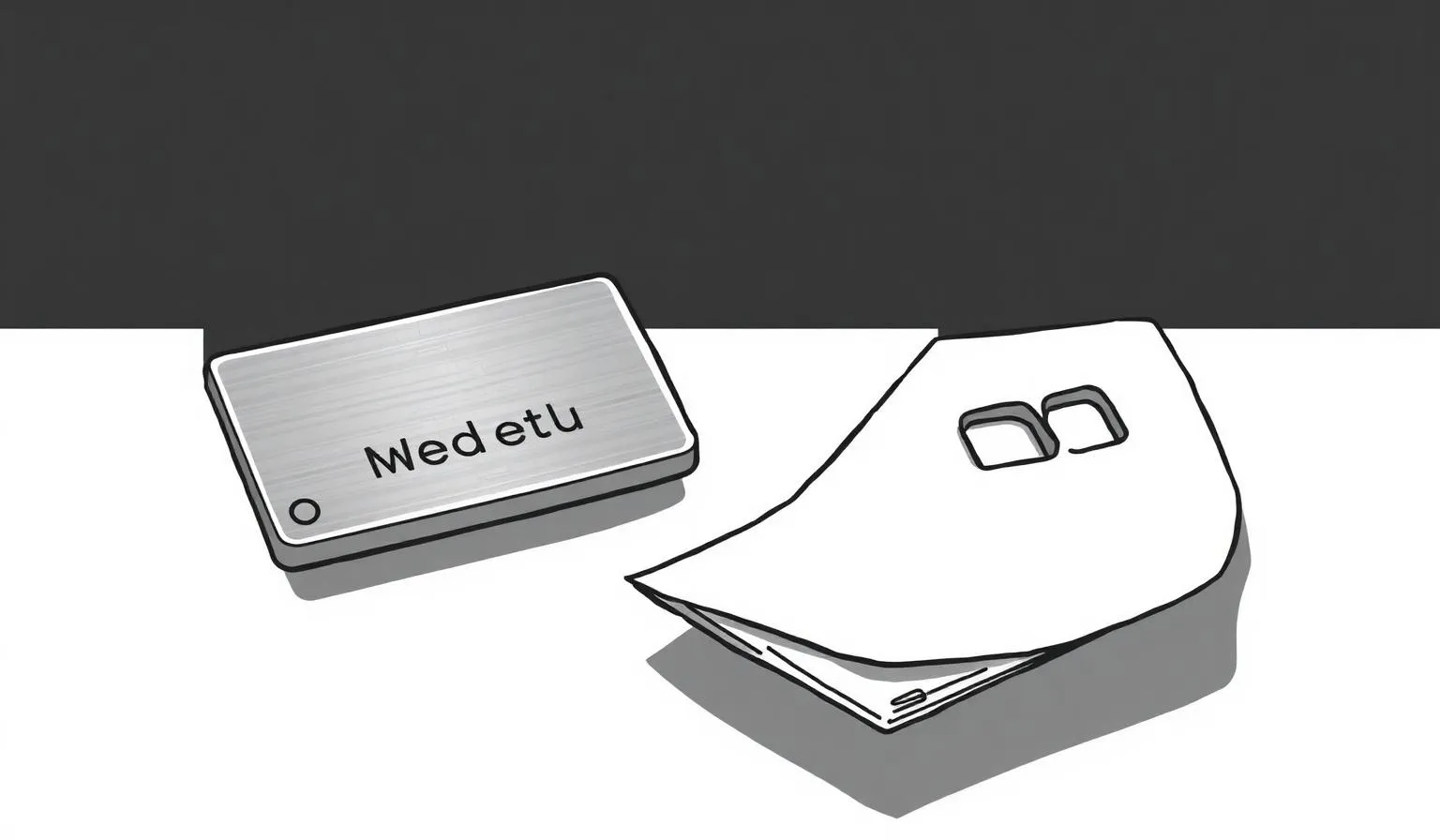
Paper is not inherently wrong — it's simply easy to do badly. If you use it, treat it as an interim solution while you set up something more durable, particularly once the amount at stake grows beyond what you'd casually risk losing. The CISA guidance on protecting sensitive information reinforces the same principle: offline, redundant, and physically controlled storage beats convenience every time. If you are deciding specifically between paper, DIY-stamped metal, and commercial metal backup products, our steel vs. paper vs. metal deep-dive covers the durability and cost differences in detail.
5. Building a Storage Plan That Fits Your Holdings
Rather than asking "what's the single best storage method," it's more useful to ask: what does my setup need to survive?
A reasonable framework:
- Write it down accurately, offline, away from cameras or onlookers, and double-check word order and spelling against the device before funding the wallet.
- Avoid a single point of failure. Keep at least two copies, in two physically separate locations, so no single event — theft, fire, flood — can wipe out your only backup.
- Match the storage medium to the stakes. Paper may be fine for a small amount you're experimenting with. For meaningful savings, a fire- and water-resistant medium like a stainless steel plate reduces the risk of the backup itself becoming the failure point.
- Control who can physically access it. A fireproof safe defeats its purpose if it sits somewhere accessible to anyone who visits your home.
- Never digitize it "just to be safe." The instinct to photograph or type out a backup as insurance is exactly what creates most real-world losses.
There's no universal answer for everyone — someone holding a small amount for occasional use has different needs than someone holding long-term savings. The goal is a setup that survives ordinary real-world accidents and human error, not just a theoretical attacker. For a deeper look at the trade-offs, see our guide to Bitcoin self-custody and how it compares to leaving funds on exchanges.
6. Testing Your Backup Before You Need It
This step is the one most beginners skip, and it's the one that catches errors while they're still fixable.
Before transferring meaningful funds into a wallet:
- Send a small, low-value test amount to the wallet.
- Wipe or factory-reset the device (or remove the wallet from your software).
- Restore the wallet using only your written backup.
- Confirm the same address and balance reappear.
- Send the test funds onward to confirm you can actually spend from the restored wallet, not just view it.
If anything goes wrong during this process, it happens with a small test amount instead of your full holdings.
7. What to Do If You Suspect Your Seed Phrase Is Compromised
If you believe your seed phrase has been exposed — through phishing, malware, a lost device, or a backup you no longer trust — treat it as urgent:
- Move funds to a new wallet with a freshly generated seed phrase as soon as possible. There is no way to "revoke" a compromised phrase; the only fix is to move funds out of its reach.
- Do this from a device you're confident is not compromised.
- Once funds are moved, the old seed phrase is permanently retired — don't reuse it for anything.
Speed matters more than perfection here. A partially rushed move to safety is better than a delayed, perfect one.
8. Key Takeaways
- A seed phrase generates every private key your wallet will ever use — treat it as more sensitive than any password you own.
- The most common losses come from digital storage, single points of failure, and untested backups — not sophisticated hacking.
- Match your storage method to what's at stake: paper can work for small amounts, but durable, offline media matters more as holdings grow.
- Always test recovery with a small amount before trusting a backup with significant funds.
- No legitimate service will ever ask for your seed phrase — treat any request for it as a scam.
9. Frequently Asked Questions
What is a seed phrase used for?
It's used to generate and restore access to every private key in a wallet. If you lose your device but still have the seed phrase, you can recover full access on a new one.
Is it safe to store a seed phrase in a password manager?
This isn't recommended. Even security-focused apps are connected to the internet in some form, which introduces risk that fully offline storage avoids.
What happens if I lose my seed phrase?
If it's the only backup and the wallet device is also lost or damaged, the funds are typically unrecoverable. There is no central authority able to restore access.
Is paper or metal better for seed phrase storage?
Paper is accessible and low-cost but vulnerable to fire, water, and fading. Metal plates cost more but withstand environmental damage far better, making them a stronger choice for long-term or larger holdings.
Can someone steal my crypto with just my seed phrase?
Yes. Anyone who has the complete, correctly ordered phrase can regenerate your private keys and move your funds. It should be treated with the same seriousness as physical cash.
Conclusion
Seed phrase security isn't about finding one perfect product — it's about eliminating the single points of failure that cause almost all real-world losses: digital exposure, single copies, untested backups, and social engineering. A setup that's boring, duplicated, and verified will outperform an expensive one that's rushed or untested. Take the time to write it down carefully, store it offline in more than one place, and confirm it works before you trust it with real funds.
Sources
- Bitcoin BIP-39 — Mnemonic Code (how seed phrases are generated)
- FTC — What to Know About Cryptocurrency and Scams
- CISA — Using Encryption to Protect Sensitive Information
Financial Disclaimer
This article is for informational and educational purposes only and should not be considered financial or investment advice. Past performance is not indicative of future results.