
Bitcoin's Rally Meets Its First Institutional Stress Test: What the Fed, ETF Flows and Ethereum's Divergence Reveal

Ashir Khan writes about cryptocurrency security, self-custody, macro market analysis, and regulatory policy at CryptoBeacon.
Market conditions as of August 30, 2026. This is a dated market snapshot.
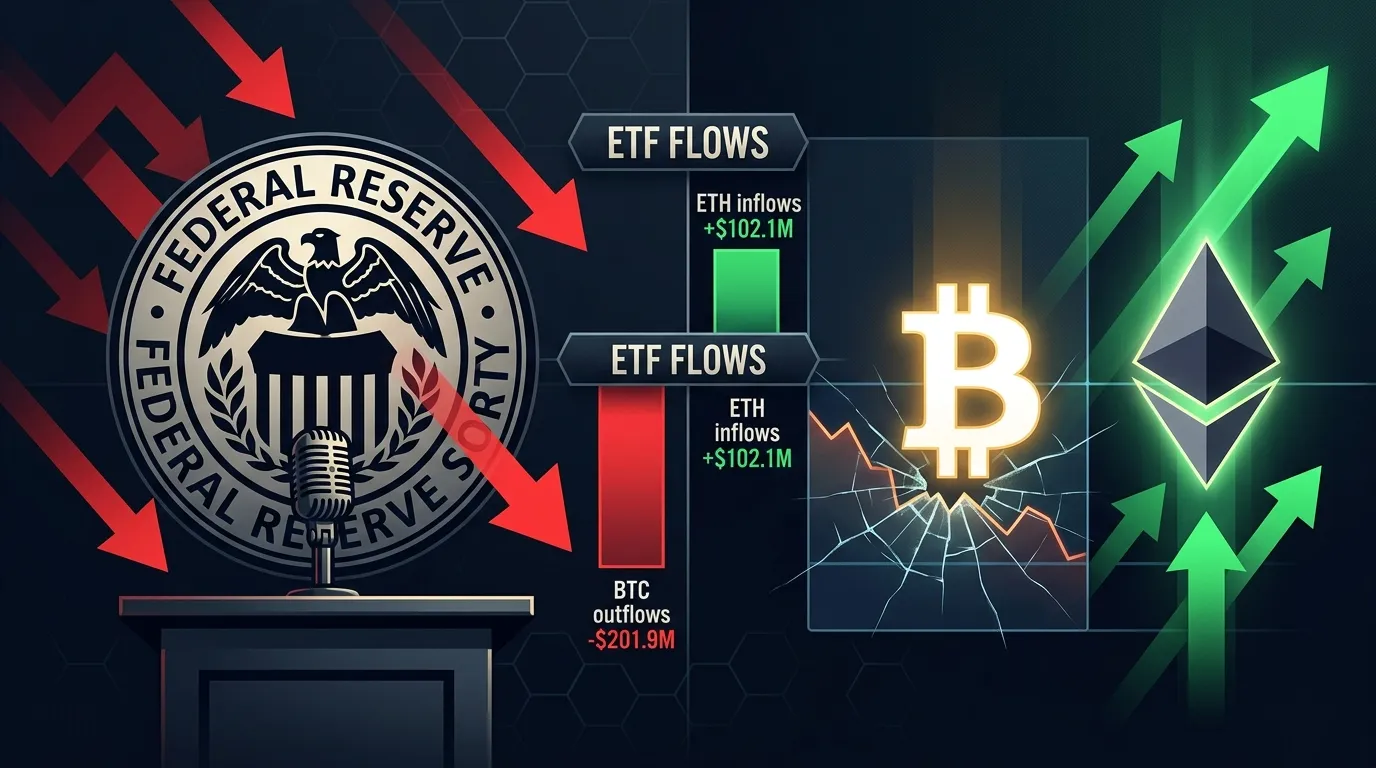
For nine consecutive trading sessions, U.S. spot Bitcoin ETFs reported net inflows — a sustained run that coincided with Bitcoin climbing from the low-$60,000s to the high-$70,000s in a matter of days. Then, on August 30, 2026, two things happened almost simultaneously: Federal Reserve Chair Kevin Warsh delivered a hawkish speech at Jackson Hole, and the ETF inflow streak ended with approximately $201.9 million in net outflows from Bitcoin funds. Bitcoin fell roughly 3% during the session, trading around the high-$70,000s by the close.
This article does not call a market top. What it does is explain what these three data points — a central bank signal, a shift in ETF flows and a divergence between Bitcoin and Ethereum — mean for how investors should read the underlying structure of the rally.
What Kevin Warsh Said at Jackson Hole — and Why It Moved Markets
Jackson Hole is the Federal Reserve's annual economic symposium in Wyoming, and it carries outsized market significance because Fed chairs have historically used the platform to preview major policy shifts. Kevin Warsh's August 30, 2026 speech was not a surprise in its direction — it emphasised persistent inflation risks and reaffirmed the Fed's commitment to its 2% inflation objective.
The market impact, however, was immediate. The speech reduced expectations for near-term interest-rate cuts. For risk assets, this matters because lower rates reduce the opportunity cost of holding non-yielding assets like Bitcoin. When rates are expected to stay higher for longer, the guaranteed return available on safe government bonds makes the case for allocating capital to Bitcoin comparatively weaker.
August 30, 2026 — Key Data Points
- Bitcoin price move: Approximately minus 3% during the session, trading around the high-$70,000s.
- Bitcoin ETF flows: Approximately minus $201.9 million net outflow, ending a nine-session inflow streak.
- Ethereum ETF flows: Approximately plus $102.1 million net inflow, extending a multi-session positive streak.
- Macro catalyst: Kevin Warsh's hawkish Jackson Hole address on inflation and monetary-policy credibility.
Why Bitcoin ETF Outflows Are a Meaningful Signal — but Not a Verdict
Understanding why ETF outflows move markets requires a brief look at how spot Bitcoin ETFs mechanically affect the spot price. When an investor buys a share in a spot Bitcoin ETF, an authorised participant creates new ETF shares by purchasing physical Bitcoin. When they redeem shares (an outflow), the underlying Bitcoin must be sold. That means ETF outflows translate directly into spot sell pressure.
After nine sessions of continuous inflows — reportedly totalling more than $3 billion according to Bitcoin Magazine, citing Farside data — the reversal carries weight. That multi-session inflow run was itself cited as a key driver of Bitcoin's rally. Ending it removes a predictable and visible source of buying demand.
That said, a single-session outflow after nine positive days is not equivalent to a confirmed trend reversal. Short-term profit-taking after a sharp rally, combined with macro uncertainty from a central bank speech, is a plausible and non-extraordinary explanation. The question that matters for the weeks ahead is whether institutional buyers return in subsequent sessions or whether the outflow persists.
The Ethereum Divergence: Rotation or Coincidence?
The most analytically interesting data point from August 30 is not the Bitcoin ETF outflow in isolation — it is the simultaneous Ethereum ETF inflow of approximately $102.1 million. On the same day that Bitcoin funds bled capital, Ethereum funds attracted it.
There are at least three explanations for this divergence, and they have very different implications:
- Institutional rotation within crypto. Some large allocators may be shifting exposure from Bitcoin to Ethereum, perhaps because Ethereum's staking yield and layer-2 ecosystem provide a return profile that is less negatively affected by higher-for-longer rates. If this is the case, the total crypto market is not losing institutional interest — it is reorganising it.
- Independent buying on different narratives. Ethereum's inflows may be driven by ETH-specific factors — upcoming protocol developments, staking yield comparisons, exchange listings — that are unrelated to the Bitcoin/Fed dynamic. The two data points would then be coincidental rather than causal.
- Profit-taking from Bitcoin, parking in ETH. A subset of investors may have reduced Bitcoin exposure after a sharp rally (locking in gains) while deploying the proceeds into Ethereum, treating the pair as a relative-value trade rather than an exit from crypto.
A single session of divergence is insufficient to confirm any of these explanations. It is, however, sufficient to make this a story worth watching: if ETH inflows continue while BTC outflows persist over multiple sessions, the rotation thesis gains traction.
How a Hawkish Fed Creates Pressure on Bitcoin — and Why It Is Not the Whole Story
The standard macro argument against Bitcoin in a hawkish rate environment runs as follows. Because Bitcoin is a non-yielding asset, it must compete for capital against yield-bearing alternatives like government bonds and money-market funds. When the Federal Reserve signals that rates will remain elevated, the risk-free yield on safe assets rises. That increases the opportunity cost of holding Bitcoin — you give up more guaranteed return to hold it.
This relationship is real, but it is not deterministic. Bitcoin has previously rallied during periods of high interest rates when other drivers — institutional adoption, regulatory clarity, halving-cycle dynamics, or ETF flow momentum — were sufficiently strong to outweigh the macro headwind. The bond-yield relationship matters more as a marginal influence than as a binary switch.
What Would Confirm a Deeper Correction vs. a Temporary Setback?
- Deeper correction signal: Multiple consecutive sessions of Bitcoin ETF net outflows exceeding $150 million, sustained over a week or more without recovery.
- Temporary setback signal: Outflows reverse within two to three sessions as macro sentiment stabilises, with Bitcoin price holding above its rally's mid-point support.
- Rotation confirmed: Ethereum ETF inflows persist for five or more sessions while Bitcoin funds remain flat or negative.
- Risk-off event: Broad equity market decline alongside crypto selling, with no ETH divergence — suggesting macro exits rather than internal rotation.
The $6.4 Billion Options Expiry: Context, Not Cause
Reports noted that a large Bitcoin options expiry — cited at approximately $6.4 billion in notional value — was scheduled around this period. Options expiries can amplify short-term price volatility because dealers hedging their positions buy or sell the underlying asset as the expiry approaches, a phenomenon known as delta hedging.
However, attributing the session's move solely to the options expiry would be an oversimplification. The Fed speech provided the directional catalyst; the options market may have amplified the move. These are complementary explanations rather than competing ones. Readers should resist any narrative that singles out the options expiry as the primary cause.
What This Means for CryptoBeacon Readers
The most useful framing for this event is as a stress test for the recent rally, not as a verdict on it. Bitcoin climbed sharply over a multi-week period supported by a visible and measurable driver: sustained ETF inflows from institutional allocators. That driver has now paused. The question is whether it resumes.
- ETF flow data is now a leading indicator worth tracking daily. The nine-session inflow streak was not a coincidence — it corresponded with a specific period of rising institutional demand. Monitoring whether it resumes is more informative than watching the price alone.
- Fed communication will continue to matter. Jackson Hole speeches are infrequent, but Federal Open Market Committee minutes and Fed Chair press conferences provide regular opportunities for market-moving signals. The relationship between monetary-policy expectations and Bitcoin demand is active, not historical.
- The Bitcoin-Ethereum divergence is a separate story worth following. If Ethereum ETF inflows persist while Bitcoin funds stagnate, it would represent a meaningful shift in how institutions are allocating within the digital-asset space — with implications for relative price performance and portfolio construction.
Flows Summary
- U.S. spot Bitcoin ETFs recorded approximately $201.9 million in net outflows on August 30, 2026.
- U.S. spot Ethereum ETFs recorded approximately $102.1 million in net inflows on the same day.
- A single session of outflows is not evidence of a trend reversal; the key signal to watch is whether flows recover or deteriorate over the next five to ten sessions.
Market Analyst Q&A
What did Kevin Warsh say at Jackson Hole that affected Bitcoin?
Federal Reserve Chair Kevin Warsh used his August 30, 2026 Jackson Hole speech to emphasise persistent inflation risks and the Fed's firm commitment to its 2% inflation target. Markets interpreted this hawkish tone as a signal that interest-rate cuts are less likely in the near term, reducing expectations for the kind of easy monetary conditions that tend to support risk assets like Bitcoin.
Why do Bitcoin ETF outflows matter for the Bitcoin price?
U.S. spot Bitcoin ETFs hold physical Bitcoin purchased directly on the open market. When authorised participants redeem ETF shares (outflows), the ETF must sell the underlying Bitcoin, removing spot demand. Sustained outflows therefore reduce a key source of buy pressure. Conversely, inflows require new Bitcoin purchases, adding to spot demand and historically correlating with price appreciation.
Does one day of ETF outflows signal a market top?
Not necessarily. A single session of outflows after nine consecutive inflow days is notable but is not sufficient evidence of a durable trend change. Short-term profit-taking, options expiry volatility and macro sentiment shifts can all produce brief outflow sessions without altering the longer-term institutional positioning picture. The critical test is whether outflows persist over multiple sessions.
Why did Ethereum ETFs see inflows while Bitcoin ETFs saw outflows?
The divergence suggests that at least some institutional capital was rotating within the crypto sector rather than exiting it entirely. Ethereum's current narratives — including staking yields and layer-2 ecosystem growth — may appeal to investors seeking different risk-return profiles. However, the single-session data is insufficient to confirm a sustained rotation; it is a signal worth monitoring, not a concluded trend.
What is the opportunity cost argument against Bitcoin in a hawkish rate environment?
Bitcoin is a non-yielding asset — it pays no interest or dividends. When the Federal Reserve signals higher-for-longer interest rates, the yield available on safe government bonds rises. This increases the opportunity cost of holding Bitcoin (you give up more guaranteed return to hold it), which makes non-yielding assets comparatively less attractive to institutional allocators benchmarked against risk-free rates.
Sources
- Axios — Coverage of Kevin Warsh's Jackson Hole Address, August 2026
- CryptoRank — Bitcoin Market Response to Jackson Hole Speech, August 30, 2026
- Crypto.news — Bitcoin ETF Outflows Report, August 30, 2026
- Binance News — ETF Flow Summary Citing Farside Data, August 30, 2026
- Bitcoin Magazine — ETF-Driven Rally and Subsequent Pullback Analysis, August 2026
- Farside Investors — Bitcoin ETF Flow Tracker
Disclaimer: This article is a factual report published on August 30, 2026, for informational purposes only. It is not financial advice. ETF flow figures are sourced from third-party reports.