The Difference Between a Coin and a Token

Ashir Khan writes about cryptocurrency security, self-custody, macro market analysis, and regulatory policy at CryptoBeacon.
In the cryptocurrency world, the words "coin" and "token" are often used interchangeably by newcomers. However, technically speaking, they represent fundamentally different types of digital assets with distinct roles and underlying infrastructure. Understanding the difference between a coin and a token is essential for evaluating crypto projects.
Understanding the Basics
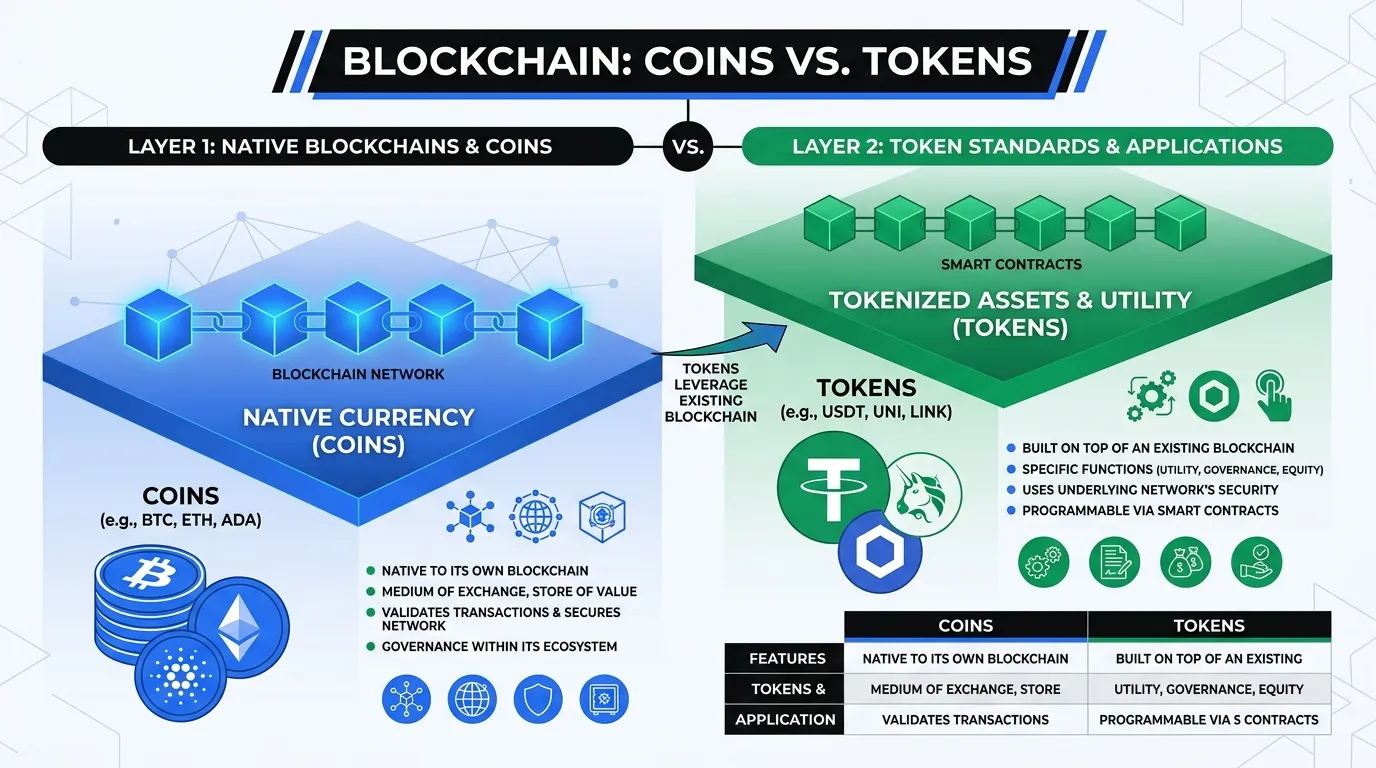
A coin is a digital asset that is native to its own blockchain and created and controlled by the protocol itself. Bitcoin (BTC) is the definitive example: it runs on the Bitcoin network, which mints it, secures it, and is paid in BTC for using its block space. Ether (ETH) is the coin of Ethereum — the asset every transaction on that network must pay in "gas." A coin's supply schedule, consensus, and security all come from its own network of miners or validators, not from any application built on top.
A token, by contrast, is created programmatically on top of an existing blockchain using smart contracts. Consider Tether (USDT): it has no chain of its own, existing instead as a contract on Ethereum, TRON, and BNB Chain all at once. Uniswap's UNI is another clear case — an ERC-20 token living on Ethereum even though Uniswap the protocol operates on no native chain. USDT and UNI move, settle, and stay secure only because their host networks record and validate them; in that sense every token is a resident on someone else's ledger.
A quick mental test separates the two: could the asset exist without the chain it currently lives on? A coin cannot — it is the chain. A token can; projects redeploy and migrate tokens between networks routinely. That mobility is also why tokens are cheap and quick to produce: issuing one is a single smart-contract deployment, whereas launching a coin means building, funding, and defending an entire network from the start.
Technical Considerations
The real difference comes down to where the rules live. A coin's rules are part of its protocol — Bitcoin's supply curve and Ethereum's validator logic are defined by the chain itself. A token's rules are a smart contract executing on someone else's protocol, with no role in the consensus that validates it.
Token standards formalize this arrangement. ERC-20, Ethereum's fungible-token standard, defines a common interface — totalSupply, balanceOf, transfer, approve, and transferFrom — plus optional fields such as name, symbol, and decimals. Because every wallet, exchange, and DeFi application already understands these functions, a new ERC-20 token becomes usable across the ecosystem on day one. BEP-20 plays the same role on BNB Chain and was deliberately modeled on ERC-20, which is why so many Ethereum tokens also circulate on BNB Chain. Related standards extend the idea — ERC-721 for non-fungible collectibles, ERC-1155 for mixed collections — but ERC-20 remains the foundation most tokens rest on.
A token has no consensus machinery of its own. When you send UNI or USDT, no separate network confirms the transfer; the host chain's validators process it under the same rules as a native asset. A token therefore inherits both the security and the constraints of its host blockchain. If the host suffers a reorg, a consensus bug, or an upgrade that changes account behavior, every token on it is affected with no say of its own — a reminder that tokens borrow trust rather than create it.
A coin carries its own consensus. Bitcoin's security rests on Bitcoin miners and the network's difficulty adjustment; Ethereum's on its staking layer — independent of whatever applications are built on top. That asymmetry also explains the effort difference: deploying a token takes minutes and a little gas, while running a coin means operating infrastructure that must be protected year-round. Projects often begin as tokens and only graduate into a coin when they can sustain an entire network on their own.
Future Outlook
The coin-versus-token distinction is becoming a legal one, and it increasingly decides how digital assets are classified, listed, and regulated around the world.
Many tokens were originally sold to fund projects, which is why regulators scrutinize them through the lens of securities law. Under the U.S. SEC's Howey test, an instrument is an investment contract when buyers contribute money to a common enterprise and expect profits from the efforts of others. Applying that reasoning, the SEC has argued that specific tokens sold in initial offerings are unregistered securities — the recurring "token-as-security" argument — while decentralized coins such as Bitcoin are treated as commodities with established market structures.
The classification carries real consequences. A security triggers registration, disclosure, and custody obligations for issuers, and exchanges may restrict or delist tokens facing such claims. A commodity, by contrast, trades through mainstream venues without those hurdles. This is why issuers and platforms now watch the coin/token line so closely: an asset's regulatory fate often hinges on how decentralized and how "token-like" it is. The debate is far from settled — U.S. courts have pushed back on blanket SEC positions, and the EU's MiCA framework draws its own line between asset-referenced and e-money tokens.
Ongoing market-structure legislation, such as the FIT21 framework proposed in the U.S., codifies the split by distinguishing "digital commodities" from securities — roughly, decentralized coins versus tokens tied to a promoter's efforts. As courts and lawmakers refine those tests, the simple question "coin or token?" becomes a practical roadmap: who must register, which venues may legally list an asset, and how decentralized a project must become to cross the line.
Key Takeaways
- A coin operates on its own proprietary blockchain (e.g., Bitcoin, Ethereum).
- A token is created on top of an existing blockchain using smart contracts (e.g., Chainlink on Ethereum).
- To transfer a token, you must pay transaction fees using the native coin of the host blockchain.
FAQ
Can a token become a coin?
Yes, if a project migrates from building on an existing blockchain (like Ethereum) to launching its own native blockchain (Mainnet), its token becomes a coin. Binance Coin (BNB) is a famous example.
Is Bitcoin a coin or a token?
Bitcoin is a coin. It runs on its own independent network (the Bitcoin blockchain).
Are tokens less valuable than coins?
Not necessarily. A token's value depends on its utility, demand, and the success of the application it powers. Some tokens have larger market caps than many Layer-1 coins.
Financial Disclaimer
This article is for informational and educational purposes only and should not be considered financial or investment advice. Past performance is not indicative of future results.